




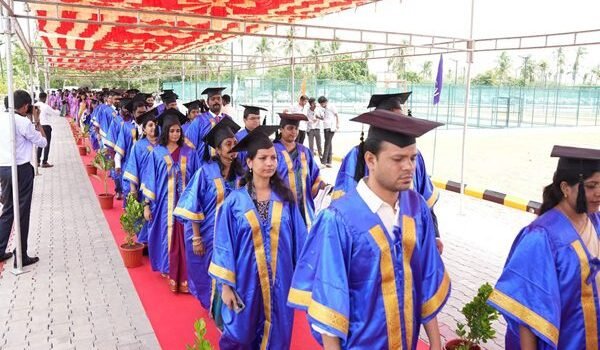
New Delhi [India], September 21: Most Indian universities talk about bridging industry and academia. Sai University has tried to build that bridge directly into its degree structure, and its Convocation on 19 September offered a fairly clear demonstration of what that looks like in practice.

The University runs eight schools, covering law, business, media, computing, allied health sciences, technology, and arts and sciences, with each designed around what the institution calls an “AI + X” approach. Rather than treating artificial intelligence as a subject reserved for a computer science degree, Sai University has built it into the foundation of nearly all its programmes, so that a law student studies AI governance and legal technology alongside constitutional law, while a media student studies AI-assisted journalism alongside reporting fundamentals.

That structure is backed by numbers that are unusually specific for a university this young. Faculty at Sai University have produced 183 publications since 2020, including 102 peer-reviewed journal papers, nearly two-thirds of them in top-tier journals, along with six granted patents and research collaborations with 77 international and 50 Indian universities. Three of its faculty members are listed among the world’s top 2% most-cited researchers in the Stanford University-Elsevier global data repository.

None of that would count for much without a route into industry, and this is where the University draws on the experience of its own leadership. Founder and Chancellor K. V. Ramani spent his career helping build India’s software industry from within, as a founding figure of NASSCOM and the founder of two technology companies. Vice-Chancellor Prof. Ajith Abraham is one of the world’s most-cited AI researchers. Their presence at the top of the institution is not incidental. It shapes hiring, curriculum design and the University’s ability to bring in industry partners for student internships and applied research.

That effort to connect academia and industry reached something of a symbolic peak at this year’s Convocation, when Padma Bhushan Shri Natarajan Chandrasekaran, Chairman of Tata Sons, accepted an honorary Doctor of Science from Sai University.

In his address to graduates, Chandrasekaran spoke about the scale of economic transformation that artificial intelligence is likely to bring over the coming decades and urged students to keep learning, stay curious and measure their own progress rather than compare themselves with others.

For a university whose founding premise is that industry and academia work best when they are not kept in separate rooms, having one of India’s most influential industrialists accept an honorary degree and use the occasion to speak directly to graduates about the future of work brought that philosophy into sharp focus at the Convocation.

About Sai University

Sai University was established by the Tamil Nadu State Legislature under the Sai University Act No. 42 of 2018 and is recognised under Section 2(f) of the University Grants Commission (UGC) Act, Government of India, as well as by the Association of Indian Universities (AIU) and the Bar Council of India.

It is positioned as India’s future-ready, AI-first university. Founded by Shri K. V. Ramani, co-founder of NASSCOM, who serves as Founder and Chancellor, the University is led by Vice-Chancellor Prof. Ajith Abraham, ranked among the top 0.01% most-cited scientists globally in engineering and computer science.

Across its eight schools, spanning Artificial Intelligence, Computing and Data Science, Law, Media Studies, Business, Allied Health Sciences, Arts and Sciences, and Technology, artificial intelligence is integrated as a foundation rather than an add-on. The University’s 103-acre campus on OMR, Chennai, includes dedicated labs for artificial intelligence, robotics, drones, allied health sciences and psychology; a functioning Moot Court for the School of Law; and a sports complex inaugurated in March 2026.

New Delhi [India], February 03: Dr. Rajkumar Rana, the founder of Madhav University, established the institution in 2013 with a visionary commitment to bringing quality higher education to Rajasthan’s tribal regions. Founded nearly fourteen years ago in a predominantly tribal and rural area where access to higher education once seemed unattainable, the university has steadily transformed the educational landscape. From a region once marked by limited academic opportunities, Madhav University today stands as a powerful symbol of inclusion, empowerment, and sustained academic progress.

Spread across a 100-acre fully developed, green, and eco-friendly campus, Madhav University offers an academic environment that seamlessly blends modern infrastructure with sustainability. The campus houses state-of-the-art laboratories, digital and physical libraries, advanced research facilities, an incubation and innovation centre, a media lab, spacious auditoriums, sports complexes, student hostels, and thoughtfully designed green spaces. Together, these facilities foster a holistic learning culture that nurtures intellectual growth, physical well-being, creativity, ethical values, and social responsibility.

Academically, Madhav University offers diploma, undergraduate, postgraduate, doctoral, professional, and medical programmes across 11 multidisciplinary faculties, including Homoeopathy, Pharmacy, Physiotherapy, Allied Health Sciences, Engineering and Technology, Commerce and Management, Law, Education, Agriculture, Arts and Science, and Yoga and Naturopathy. This wide academic spectrum allows students from diverse socio-economic and academic backgrounds to pursue professional, liberal, and research-oriented pathways within a single institution, ensuring flexibility, interdisciplinarity, and comprehensive academic development.

A defining strength of Madhav University is its deep commitment to inclusive and equitable education, particularly for tribal and rural communities. In a landmark initiative aimed at tribal belt development, Dr. Rajkumar Rana approved tuition-free admission for 200 meritorious and deserving students, with the support of the local MLA and District Pramukh. These students are enrolled across multiple faculties without paying tuition fees, significantly reducing financial barriers to higher education. The university further supports learners through need-based initiatives such as the Single Girl Child Scholarship, scholarships for widows and economically disadvantaged students, concessional fee structures for local residents, and scholarships for children who have lost their father. Other notable government-supported schemes include the Kalibai Bheel Meritorious Girl Student Scooty Scheme, Devnarayan Girl Student Scooty Scheme, Rajasthan Agriculture Girls Scholarship (for female students of the Agriculture Faculty), Department of Social Justice and Empowerment, Jaipur – Post-Matric Scholarship, and the National Scholarship. For many first-generation learners and students from marginalized backgrounds, Madhav University has become a crucial gateway to academic advancement and professional mobility.

One of the university’s most distinctive and nationally significant initiatives is its on-campus school for special-abled tribal children, making Madhav University the only private university in India to operate such a facility. More than 100 children receive completely free education, daily transportation from remote villages, comprehensive medical care, medicines, speech therapy, physiotherapy, occupational therapy, psychological assessment, and continuous developmental monitoring. The school provides a safe, structured, and emotionally supportive environment, reflecting the university’s deep commitment to inclusive education, social justice, and human dignity.

Beyond classrooms, Madhav University integrates learning with real-world service. Medical and allied health students gain hands-on practical experience through free health camps conducted in adopted villages such as Wada, Bharja, Bhujela, Kasindra, Achpura, and Amthala, as well as nearby villages including Jodphali, Kivarli, Dhanari, and several others. These camps enable students to apply theoretical knowledge in real-life healthcare settings while serving tribal and rural populations. Over the years, the university has organised more than 500 medical and health camps, addressing general healthcare, tobacco and AIDS awareness, girls’ hygiene education, staff wellness, and preventive healthcare. Legal awareness and legal aid camps further strengthen grassroots empowerment.

Madhav University’s role as a socially responsible institution is also reflected in its sustained community outreach initiatives. Regular philanthropic activities, such as the distribution of stationery, clothes, jackets, blankets, helmets, and essential supplies, have made a tangible impact on surrounding communities. Through consistent engagement in health awareness, women empowerment, sustainability, skill development, and rural outreach, the university actively contributes to regional development, reinforcing its identity as an education leader rooted in service.

A major pillar of this commitment is the Madhav Centre for Sustainability Development (MCSD), which aligns the university’s activities with the United Nations Sustainable Development Goals (SDGs). Currently working actively on 9 out of the 17 SDGs, MCSD conducts sustainability-driven programmes, awareness campaigns, and community-based initiatives in nearby villages of Sirohi district, integrating education, environment, and social development.

Student success remains central to the university’s mission. Approximately 500 students of Madhav University have secured government jobs, a remarkable achievement for a tribal and rural region. This milestone reflects the institution’s strong academic foundation, skill-oriented training, and focused guidance, significantly enhancing socio-economic mobility among its graduates.

Madhav University also promotes leadership, discipline, and national service through its NCC and NSS units. As the Unnat Bharat Abhiyan Nodal Institution for Sirohi district, the university plays a pivotal role in rural transformation and community-based development initiatives. Its consistent outreach and cultural engagement have earned recognition from IIT Jodhpur for achieving the highest level of activities in Western Rajasthan. Regular national and international seminars, conferences, faculty development programmes, research workshops, and a robust training and placement ecosystem further strengthen the university’s academic standing and student employability.

In recognition of its commitment to quality, governance, and academic excellence, Madhav University has been accredited with an ‘A’ Grade by NAAC in its first cycle and is approved by the University Grants Commission (UGC). The university is recognised by all major statutory and professional bodies, including BCI, PCI, NCTE, NCH, RNC, CCH, and RCI, underscoring its adherence to national standards and transparent governance.

Looking ahead, Madhav University is focused on strengthening research, innovation, sustainability, and global engagement, with aspirations to achieve a higher NAAC grade, secure a place among the NIRF Top 100 universities, and expand international collaborations. Deeply rooted in its regional mission yet guided by a forward-looking vision, Madhav University continues to shape futures, transforming not only individual lives but also the educational and social landscape of Rajasthan’s tribal belt through the enduring power of education.