
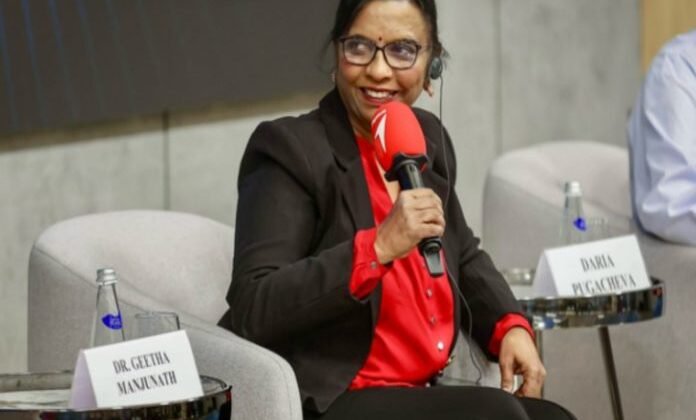


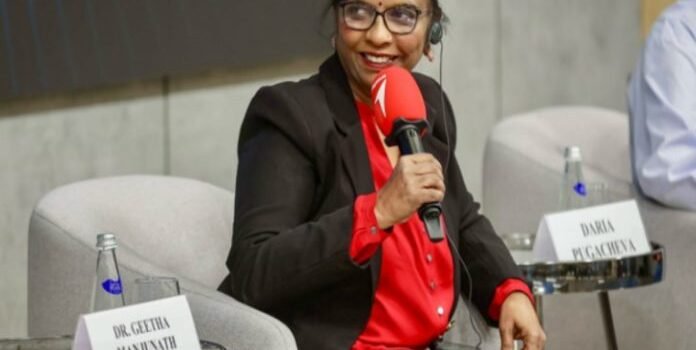
Moscow [Russia], November 16: The III International Symposium “Inventing the Future” was held at the National Centre RUSSIA in Moscow. This year, India was represented among the speakers by Geetha Manjunath, a Fellow of the Indian National Academy of Engineering (INAE) and the founder and CEO of Bengaluru-based startup Niramai Health Analytix. In her address, she spoke about Thermalytix, a breast cancer screening method based on thermal imaging and artificial intelligence.
The subject is particularly relevant to India, where only around 1–2% of women undergo regular screening and late diagnosis remains one of the reasons for the high mortality rate from breast cancer. The technology does not use ionising radiation or require breast compression. Manjunath also spoke about efforts to make such screening more accessible, including in the home.
During the session “Progress in the First Person: Women Shaping the Future”, she highlighted the potential for scientific and technological cooperation with Russia:
“I am the only speaker from India at this Symposium, and it is a great honour to represent my country here. We hope to see collaboration between Russia and India in science and cultural exchange,” Geetha Manjunath said.
The Indian expert’s participation continues a tradition of Indian representation at the Symposium. In previous years, speakers included Laxman Kumar Behera of the Institute for Defence Studies and Analyses in 2024. The event has also provided another platform for strengthening the strategic partnership between Russia and India, both within BRICS and through bilateral ties, in science, technology, healthcare and culture.
This year, the Symposium brought together more than 8,000 participants from 109 countries. It is one of the key events in the global ecosystem of the Open Dialogue, “The Future of the World: A New Platform for Global Growth”.
Russian President Vladimir Putin sent a message of greeting to the participants, organisers and guests. He noted the event’s international standing and the practical significance of the ideas emerging from the Symposium.
Maxim Oreshkin, a Russian economist, officially opened the event on 12 November. He highlighted the project’s growing momentum and international standing: representatives of 19 additional countries joined the Symposium in 2026. Oreshkin also announced the opening of applications for the third season of the Open Dialogue. Entries can be submitted at dialog.russia.ru.

Russian economist Maxim Oreshkin. Photo: Press Office of the National Centre RUSSIA
“In the new cycle of the Open Dialogue, we will focus on people in a new world. We invite authors to concentrate on four areas: ‘Human Development’, ‘Health Management’, ‘Life Around Us’ and ‘Content in a New Era’. The most compelling ideas will form the basis of a new report. We look forward to welcoming the authors of the best submissions to Moscow in April,” Maxim Oreshkin said.
The III International Symposium “Inventing the Future” offered a space to consider the balance between innovation and opportunities to realise human potential. Participants examined leading practices from around the world while keeping to a central principle: people must remain at the heart of technological transformation. The programme was organised around three tracks: “Human and Values”, “Progress”, and “Culture and the Arts”.

Natalia Virtuozova, Director General of the National Centre RUSSIA. Photo: Press Office of the National Centre RUSSIA
Natalia Virtuozova, Director General of the National Centre RUSSIA, spoke about the significance of the event and the Centre’s role as a space for dialogue on an equal footing:
“The National Centre RUSSIA is a space for national pride and international dialogue on an equal footing. We are pleased that the Symposium is expanding: this year, representatives of 109 countries joined us. Progress serves people, while culture and traditional values are our foundation. Each of the 8,000 participants will take away new ideas,” Natalia Virtuozova said.
A special gaming project, included in the Symposium’s programme for the first time, is of particular interest to Indian audiences: the Gaming Lobby “Gaming Session of the Future”. India is among the world’s largest gaming markets, particularly in mobile gaming and esports, and the venue brought together game development experts, developers and gaming fans.

Gaming Lobby “Gaming Session of the Future”. Photo: Press Office of the National Centre RUSSIA
Participants discussed video games as a cultural phenomenon and explored new Russian releases. The main presentation featured DISTORTION, a Russian story-driven action RPG. Its gameplay combines RPG elements — melee and ranged combat and character progression — with strategy elements, including building settlements and interacting with other settlements. The developers shared the results of the first round of testing, their analysis and plans to expand the game’s universe.
The programme also included educational lectures, discussions and training sessions, as well as conversations about the balance between innovation and tradition. These covered traditional crafts and the new Young Artisans School, which is due to open at the Centre in 2027.