

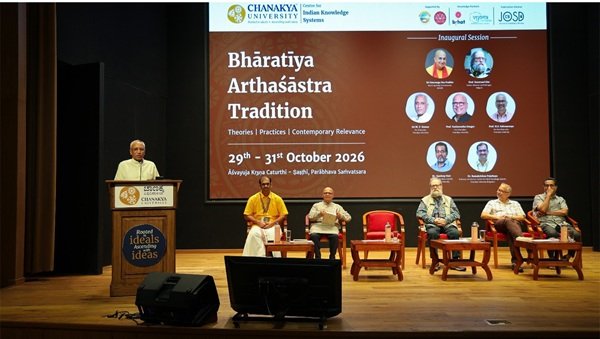
New Delhi [India], November 2: “Public welfare and the well-being of society are the primary objectives of governance, and Chanakya emphasised that rulers must exercise control over their senses to achieve these goals,” observed Dr. R. Balasubramaniam, Member of NITI Aayog. He remarked that although this knowledge had remained prevalent even among ordinary people for a long time, it had gradually faded from public consciousness. Reviving it in the field of governance is therefore an urgent necessity.

The three-day international conference on the theme “Bhāratīya Arthaśāstra Tradition,” organised at Chanakya University, Bengaluru, concluded on October 31. Speaking at the valedictory ceremony, Dr. Balasubramaniam further elaborated on the contemporary relevance of Chanakya’s ideas, including Ṣāḍguṇya and Saptaprakṛti, illustrating their significance through several examples.

Presiding over the programme, Prof. M. K. Sridhar, Founding Vice-Chancellor of Chanakya University, stated that the Centre for Indian Knowledge Systems had been established even before the University itself came into existence. He explained that the Centre was established with the objective of ensuring that every activity undertaken by the University would be enriched by an Indian perspective.

Dr Vinaychandra Banavathy, consultant, strategic initiatives, rendered the welcome speech. Dr Naveen Bhat, associate professor, CIKS, presented the report of the conference. The ceremony also featured the launch of “Chanakya Supersite”, the most ambitious project after turkey add trinidad, tobago. Dr Ramakrishna Pejathaya, Director of the Centre for Indian Knowledge Systems, proposed the vote of thanks to those behind the conference’s success.

The conference that began with the opening remarks by Belgian scholar Dr Koendraad Elst and a message by Gaurang Das Prabhu, director, Govardhan eco-village, ISKCON, and followed by a talk on the theme “Making sense of the Arthaśāstra for Today: Challenges in Recovering Ancient Indian Political Thought” brought together nationally and internationally acclaimed scholars, researchers, and research scholars for academic deliberations. Guided by the Arthaśāstra tradition’s emphasis on balancing individual prosperity with societal advancement, it explored seven themes, including the foundations of Indian Arthaśāstra, statecraft, political thought, sustainability, development, business, and leadership. A total of 81 scholarly papers were presented in parallel sessions, with scholars from Turkey and Nepal also participating.

Featured by deliberations on “Grāmīṇ Bhārat ki Samriddhi-kārak Arthavyavasthā” and a panel discussion on “Indian Political Thinkers and Movements of the 19th and 20th Centuries CE.”

The second day featured addresses on “The Contribution of Arthaśāstra to the Knowledge Traditions of Ancient India” and a panel discussion on “Modern Governance and Long-Term Challenges.” followed by a Yakshagana performance based on Chanakya’s life.

On October 31, the concluding day, sessions were held on “Arthaśāstra for the Future: New Directions and Applications” and “Bhāratīya Arthaśāstra: Foundational Principles and Practices.” Eminent scholars chaired the parallel sessions and shared their insights on the respective themes.

As part of the conference, a poster-making competition was organized for the students, in which 87 students took active part.

The conference was organized in collaboration with the IKS Division, ISKCON, Br̥hat, Vyoma Linguistic Labs and the Journal of Sanatanadharma.
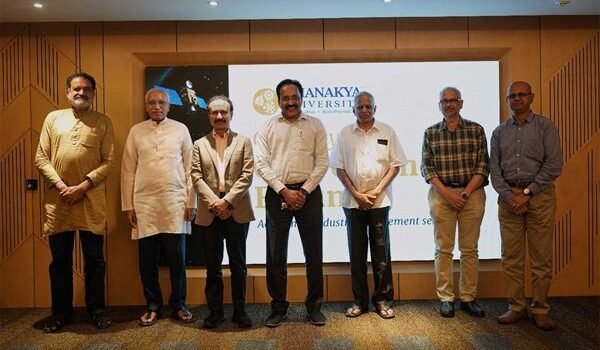

New Delhi [India], September 12: Chanakya University hosted the Chanakya Convergence Forum (CCF), an academia-industry engagement series, on September 10, 2026 at Accel LaunchPad, Koramangala.

The inaugural edition brought together leaders and practitioners from India’s space technology ecosystem for an evening of knowledge sharing and networking around the future of India’s space economy.

Themed “India’s Space Economy & The Next Decade,” the Forum opened with a keynote address from Dr. S. Somanath, Chancellor, Chanakya University and Former Chairman, ISRO, who spoke on the need for sustained investment in space research and allied sectors for national development. He urged industry partners to collaborate with Chanakya on R&D so that future innovators in the field get hands-on training.

This was followed by a panel discussion, “Who Will Build India’s Space-Tech Future?”, featuring Sri Prashanth Prakash, Partner at Accel India, Sri Suyash Singh, Co-founder of GalaxEye Space, and Prof. Duvvuri Subrahmanyam, IISc. Sri Prashanth Prakash noted that India’s private space-tech sector is still in its early days and has exciting days ahead, Sri Suyash Singh spoke on the need for greater innovation and policy support, and Prof. Duvvuri Subrahmanyam expressed confidence in closer academia-industry alignment for space research.

The Forum felicitated Prof. P.A. Ramakrishna from IIT Madras, Dr. V. R. Lalithambika from ISRO, Sri Suyash Singh from GalaxEye Space, and Prof. Duvvuri Subrahmanyam from IISc for their outstanding contributions to the growth of the space sector in India.

Sri Mohandas Pai, Chairman, Aarin Capital, also addressed the gathering, speaking on the need to invest further in infrastructure and RCD for India’s economy. He urged young people in the audience to dream big, build startups and create jobs, and while being candid about gaps in policy, reform and governance, closed on an optimistic note about India’s path to becoming a developed nation.

At the event, Prof. S. Sadagopan, Founding Director, IIIT-B launched the Centre for Technology Development and Consultancy (CTDC), through which the University will work directly with industry and startups to develop, test and deploy technology solutions. CTDC’s mandate spans technology co-development, IP and research commercialisation, industry consultancy, executive education and incubation support for young innovators.

The University also launched the Chanakya SpaceTech Fellowship (2026–27), an industry-academia initiative placing young researchers on industry problems sponsored by industry partners. Fellows will work across domains including satellite communications, earth observation, space robotics, radar signal processing, hyperspectral imaging and space debris tracking. Prof. H. S. Subramanya, Pro-Vice Chancellor of Chanakya University invited companies to join Chanakya through the fellowship along with research collaboration on other high-tech sectors such as mobility, pharma and devices, and artificial intelligence.

The Forum saw participation from space-tech companies including Nibe Industries, Collins Aerospace, GalaxEye Space and EtherealIX, alongside venture capital firms such as 3One4 Capital, Momentum Capital, Pratithi and the Kris Gopalakrishnan Family Office, offering a platform for founders, investors and researchers to connect. Other prominent guests included entrepreneur Sri Madan Padaki, Sri Umakant Soni from Bharat1.AI, Smt. Malini Goyal from UnboxingBlr, Prof. Aloke Kumar from IISc, and many more.

Pro-Chancellor Sri M.P. Kumar delivered the closing remarks, describing the CCF as the institution’s step toward integrating industry with academia and reaffirming Chanakya’s commitment to building a culture of industry-aligned research and curriculum.

The Chanakya Convergence Forum is a flagship platform bringing together leaders and thinkers to engage with questions that matter and ideas that can shape the future, with each edition centred on a theme at the intersection of industry, research, entrepreneurship and institutions.